
Robotic Laser Welding
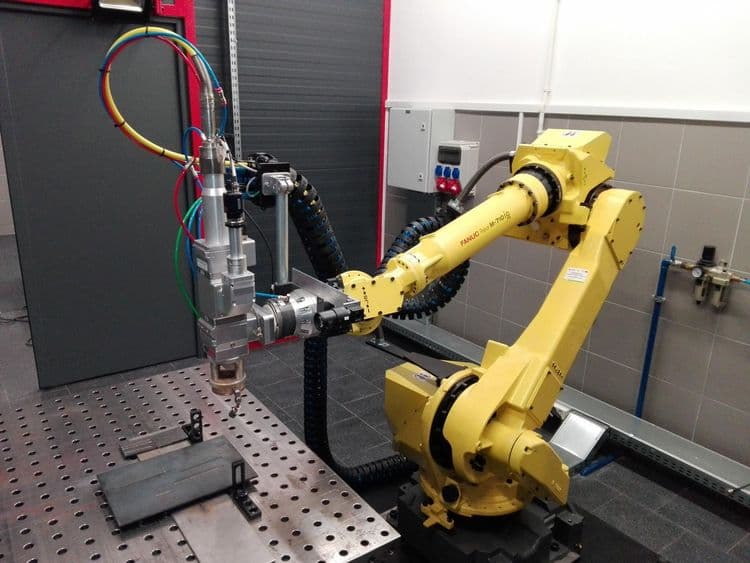
CipherFab offers a high-quality robotic laser welding service using six-axis industrial robot arms mounted with fibre laser welding heads — delivering fully automated, high-speed precision weld seams with minimal heat input, minimal distortion, and weld bead widths as narrow as 0.1 mm.
CipherFAB values your privacy and security. Learn More
Get an Instant Robotic Laser Welding Quote
Upload your CAD FilesSupported files: STEP, STP, SLDPRT, DXF, IPT, PRT, SAT
Robotic Laser Welding Service
CipherFab offers a high-quality robotic laser welding service using six-axis industrial robot arms mounted with fibre laser welding heads — delivering fully automated, high-speed precision weld seams with minimal heat input, minimal distortion, and weld bead widths as narrow as 0.1 mm. Robotic laser welding eliminates operator variability entirely — every weld seam is deposited at the exact same speed, power, and focal position, controlled by the robot programme and monitored by integrated seam tracking and process monitoring systems. CipherFab provides instant quotes on robotic laser welded assemblies with DFM feedback on every uploaded file.
Recommended Materials for Robotic Laser Welding
Materials supported for this capability.
Robotic Laser Welding
Seam Tracking Laser seam tracking sensors monitor joint position in real time throughout the weld cycle, compensating for fixturing variation and maintaining focal accuracy to ±0.05 mm.
- Metals — Fibre Laser (1.064 µm) Stainless Steel 304 / 304L
- Stainless Steel 316 / 316L
- Stainless Steel 17-4PH
- Mild Steel 1018
- Galvanised Steel G90
- Aluminium 5052
- Aluminium 6061
- Aluminium 7075
- Titanium Ti-6Al-4V
- Inconel 625
- Inconel 718
- Copper 110
- Nickel 200 (battery tab)
- Kovar
- Weld Joint Types Butt joint
- Lap joint
- T-joint
- Corner joint
- Edge joint
- Fillet joint
- Hermetic seam weld
- Continuous seam
- Stitch (pulse) weld
- Laser Power Range 1.5 kW
- 3 kW
- 4 kW
- 6 kW
- 8 kW
- 10 kW — matched to material and weld penetration requirement
Tolerance Standards for Robotic Laser Welding
General tolerance information for this capability.
Robotic Laser Welding
| Description | General Tolerance |
|---|---|
| Robotic Arm Repeatability | ±0.05 mm (±0.002″) — high-accuracy laser welding robot |
| Weld Bead Width (minimum) | 0.1 mm (100 µm) |
| Weld Seam Positional Accuracy | ±0.05 mm with integrated seam tracking |
| Heat-Affected Zone | 0.5–1.0 mm typical — lowest of any robotic welding process |
| Weld Travel Speed | 3,000–8,000 mm/min (4 kW–10 kW fibre laser systems) |
| Penetration Depth (single pass) | Up to 12 mm depending on laser power and material |
| Weld Quality Standard | ISO 5817 Level B (high quality) as standard |
| AWS Standard | AWS D1.1 (steel) · AWS D1.2 (aluminium) |
| Dimensional Tolerance (post-weld) | ±0.010″ — tighter than any arc welding process |
| Distortion | Minimal — low heat input and high travel speed prevent bulk thermal distortion |
| Safety Standards | ISO 11553 (laser processing machines) · ANSI Z136 (safe laser use) |
| NDT Options | Visual · Dye penetrant · Ultrasonic · Radiographic testing |
Design Guide: Robotic Laser Welding
We have compiled our best tips into this guide to help you understand robotic laser welding processes, how to design weld joints for laser access and robotic reach, joint fit-up and gap requirements for autogenous laser welding, seam tracking compatibility, fixture design for consistent part presentation, material reflectivity and surface preparation requirements, hermetic seam weld design, and how to specify weld quality level and inspection requirements for robotic laser welded assemblies.
Advantages of Robotic Laser Welding
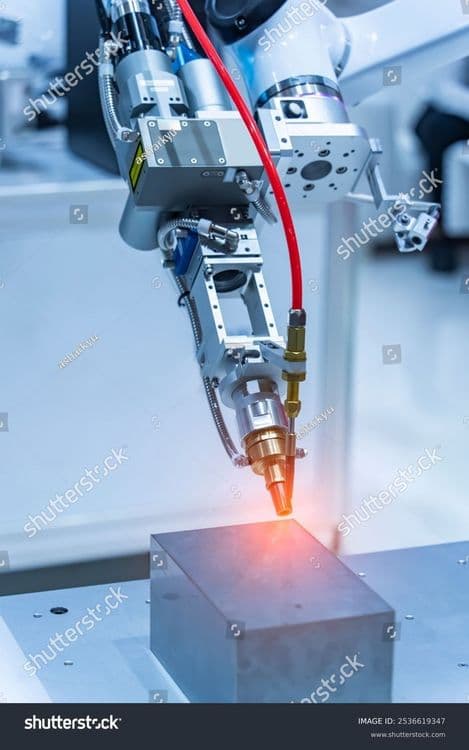
Robotic laser welding combines the two most important advantages in precision weld manufacturing — the lowest heat input of any fusion welding process, and the elimination of human operator variability. A fibre laser robot delivers weld travel speeds of 3,000–8,000 mm/min — five to twenty times faster than manual TIG welding — with heat-affected zones measured in fractions of a millimetre, and weld bead positional repeatability of ±0.05 mm across every unit in a production run. For battery module tab welding, automotive body seam welding, aerospace titanium structural joints, medical device hermetic sealing, and precision electronics enclosure welding — where dimensional consistency across every unit is non-negotiable and distortion must be minimised — CipherFab's robotic laser welding service delivers the speed, precision, and process documentation that high-volume precision weld programmes demand. All robotic laser welding cells comply with ISO 11553 and ANSI Z136 laser safety standards, with full guarding, interlocks, and trained laser safety officers on every production shift.



Start Your Robotic Laser Welding Project Today
Get Free Instant QuoteUpload your CAD files for an instant quote with DFM feedback on every order.